
MARKET REPORT
AUTUMN 2023

The supply chain for flash memory has vastly improved on the situation a year ago. There is generally plenty of product available, though with some variances. Commodity products such as consumer grade flash memory is in very good supply, but there are lead times with some higher end and specialist products.
Cardwave has good visibility of product at all grades from consumer to specialist, and can generally plan ahead, and ensure adequate supply for our customers.
The market is in oversupply
The market for flash memory is now, in general, in oversupply. While there is still some shortage of supply in higher end and specialist products, the vast majority of flash memory products are now relatively easy to source.
This means the market is more competitive and manufacturers are forced to sometimes go outside their usual strategies to win business. Two factors in particular are at play:
These factors of oversupply and increased competition create a buyers’ market – a business dynamic which gives considerable power to purchasers who are ready to shop around and negotiate on areas like price and delivery. This in turn puts pressure on all suppliers (both brands and manufacturers) to promote the quality and differentiation of their products as well as how they service and support customers.
It can also lead to the rise of ‘bargain basement’ pricing to offload inventory that has not met quality thresholds or to sell overproduced inventory quickly rather than pay to store it. This could cause some buyers to acquire product that does not meet their requirements because they are lured by price.

Above: The combination of oversupply and increased competition due to the entry of new brands can add complexity to purchasing decisions.
A move towards rebalancing
The natural response to oversupply and the existence of a buyers’ market is for manufacturers to rebalance production, and we are seeing this happen through both job cuts and reductions in production output. This will increase the need for buyers to compete for product, and allow fabricators to stabilise and then to increase prices.
This ebb and flow can put buyers at risk of financial difficulty as they have to accommodate supply chain stresses and price rises. This is where working with a trusted third party pays dividends.
Cardwave maintains strong relationships with our supply chain partners, and we never jump in and buy at the lowest price. We are not a commodity broker. We value our supply chain partners as much as we value our customers, and our goal is always to provide high quality, value added services. We have many long term relationships with customers, and we always aim to provide an integrated long term solution – not quick fixes.

Above: Fabricators must plan ahead to ensure they produce the right products in the right quantities.
caption
Understanding trends to plan ahead
The production of flash memory is complex. It requires sourcing of raw material and the construction and maintenance of plant. Plant owners need to be assured of income in order to justify the investment necessary to operate and to be profitable. Rapid advances in fabrication technologies and product capabilities means continual investment and upgrading will be necessary.
Decisions about what fabricators are making today will have been made some while ago. Fabrication plants always need to be several steps ahead of actual manufacturing, looking to the immediate, mid and longer term futures, making decisions years ahead rather than weeks or months.
Planning what to make and in what quantities is influenced by market trends as well as trends in technology development. As flash memory is a key component in a huge array of products spanning consumer, corporate, health, defence and other sectors, fabrication plants need to be up to date with current and future trends in a wide spectrum of market areas.
The Covid-19 pandemic accelerated some areas of high use of flash memory, such as corporate digital transformation and cloud based computing. In addition the Internet of Things market, which relies heavily on embedded flash memory, continues to grow at speed. But the financial uncertainty that is currently prevalent in many nations is related to a slowdown in some areas such as the purchase of consumer goods.
At the same time as real world conditions affect purchasing, technology development continues – for example the SD standard is now at version 9, and has a roadmap that brings in new functionality including fast boot and secure boot – both of which are very relevant to the growing Internet of Things market.
Realigning manufacturing dependency
One effect of the Covid-19 pandemic and global uncertainty has been recognition of how dependent the West is on China and Taiwan for the flash memory that is increasingly important to many aspects of modern life. This recognition relates particularly to embedded flash memory which is at the heart of so many devices, from consumer goods to complex medical, military and manufacturing systems. Demand for such memory can only grow.
The majority of semiconductor fabrication takes place in Taiwan, with some in China. Meanwhile China does a lot of final assembly and packaging for western companies. As the West reduces its purchasing of Chinese product, it is cutting the supply chain. This means China has to invest in its own technology and build out its own supply chain, predominantly aimed at the home market. The supply chain for fabricators is complex. It involves not only the acquisition of raw materials, but also the use of lithographic technology – a combination of hardware and software which allow semiconductors to be produced onto the circular wafers from which they are then individually cut. Dutch company ASML is the world leader in providing lithographic technology.

Outside of China and Taiwan new plants are beginning to emerge, for example in Malaysia, India, Vietnam and the US. But at present these plants are playing catchup. The significant financial investment required, build time, and the need for people with technical expertise, coupled with rising demand, mean the West remains some way off being self-sufficient. It is notable that the geographies where new plants are being developed are those where the required skillsets exist.
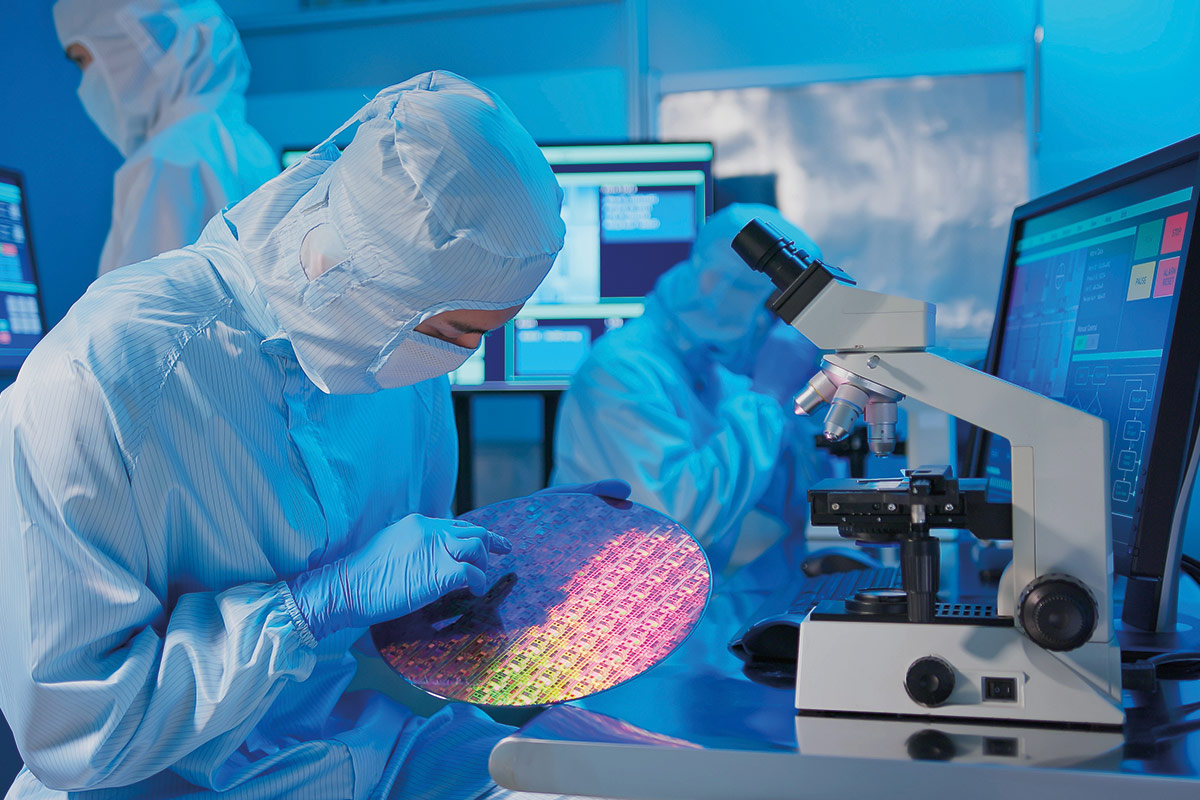
Semiconductor fabrication currently takes place primarily in Taiwan, with some in China. This situation may change in the future as other nations take steps to become fabricators in order to reduce their reliance on Taiwan and China. However significant investment is required to set up a fabrication plant, and self sufficiency is a long way into the future.
Recent legislation such as the 2022 US CHIPs and Science Act designed to boost American semiconductor research, development and production, and the EU Chips Act, approved by the Council of the European Union in July 2023 designed to create the conditions for the development of a European industrial base in the field of semiconductors is a starting gun to what will likely prove to be a marathon, not a sprint.
As far as the UK is concerned, fabrication is not a financially viable option. Instead, focus here is on areas of innovation including research and development and artificial intelligence. This plays to the UK’s strengths, and time will tell if it reaps significant rewards.
What Cardwave sees today
Outlook
About Cardwave
Cardwave provides consultancy services to help device makers select memory for their products. We help our customers find the right memory, in the right quantity, at the right price. We work with leading suppliers across the globe, have excellent networking links, and strong supply chain routes. We provision, package and ship product globally.


